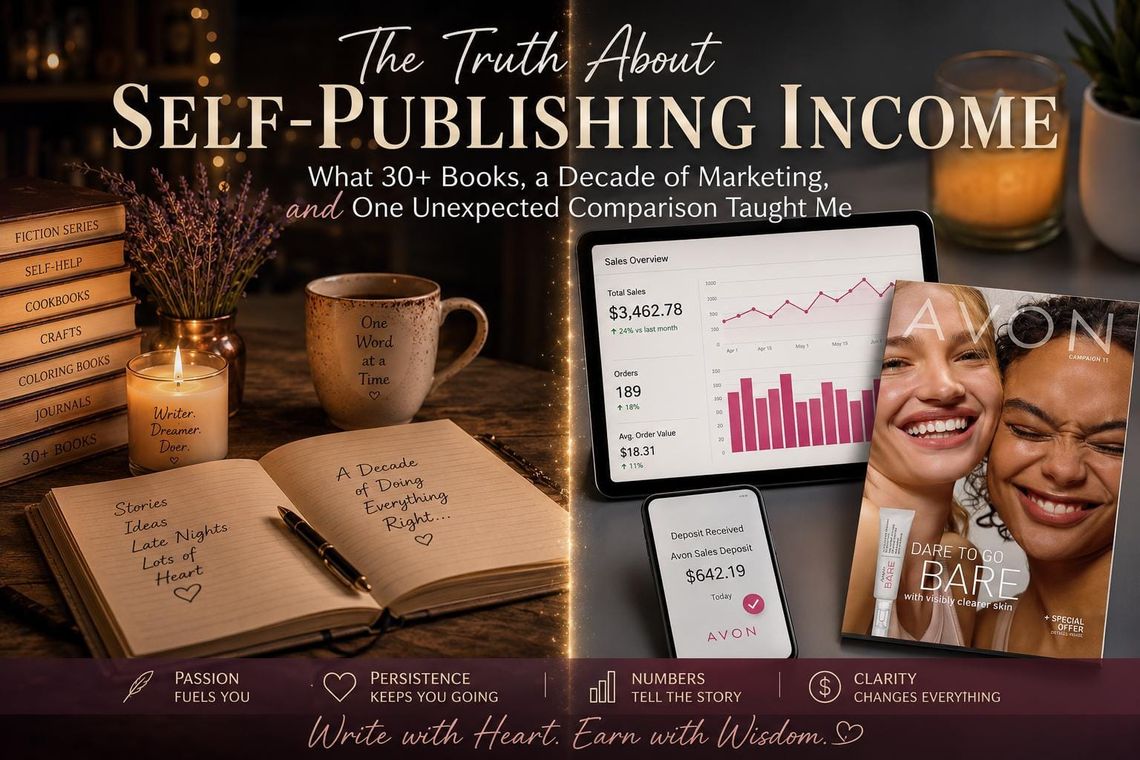
The Truth About Self-Publishing Income
What 30+ Books, a Decade of Marketing, and One Unexpected Comparison Taught Me
I want to have an honest conversation with you today. Not a motivational speech. Not a “you can do it!” pep talk. An actual, look-you-in-the-eye conversation about what self-publishing income really looks like — from someone who has been in the trenches for over a decade and has the royalty statements to prove it.
Or, more accurately, the royalty statements that make me laugh so I don’t cry.
I’ve published more than 30 books. Let that number settle for a moment. Thirty. Books. (To be accurate...52 in eBook format at this writing.) A fiction series, multiple self-help titles, diet and nutrition guides, cookbooks, crafting books, coloring books, and low-content journals. I’ve written across genres, experimented with formats, chased trends (carefully), and stayed true to my niche (persistently). I am not a dabbler. I am not someone who uploaded a half-finished manuscript and expected magic.
I did the things. All of them. And I want to tell you what happened.
The Investment
Let me be specific, because vague encouragement has never helped anyone build a real business.
Over the years, I invested in professional editing for my manuscripts — not because I’m a poor writer, but because I understand that the gap between a good book and a marketable book often lives in the hands of a skilled editor. I paid for professional cover design, because yes, people absolutely judge books by their covers, and a homemade cover in a competitive market is the equivalent of showing up to a job interview in pajamas. I paid for interior formatting. I did this the right way.
On the marketing side: I built a combined social media following of over 12,000 people across platforms — and I posted consistently, with real content, real personality, real connection. I grew an email subscriber list of approximately 1,000 readers. I ran paid advertising campaigns on both Amazon and Facebook, testing copy, images, audiences, and budgets. I built an author website. I showed up. Month after month, year after year.
I also built SelfPublishedAuthor.com as a resource community, connecting with hundreds of other indie authors. I understand this business from multiple angles — not just my own bookshelf, but the broader landscape.
The Reality
Here is what I have discovered after more than a decade of doing everything right by the book (pun fully intended):
Self-publishing income is real. It exists. I am not here to tell you it doesn’t. But for the vast majority of indie authors — even hardworking, talented, prolific ones — it is deeply, stubbornly, almost defiantly slow to materialize into anything resembling a living wage.
The royalty rates sound appealing on paper: 70% on Kindle ebooks in certain price ranges, 60% on print after costs. But 70% of $2.99 is about $2.09. Sell a hundred copies in a month — which is genuinely not easy to do, even with marketing — and you’ve grossed $209. Before you account for advertising spend. Before you account for the editing and cover design costs you amortize across the life of that book. Before you account for the hours of your time.
Multiply that across a catalog. Add in the lower royalties on print. Factor in the months where sales dip because Amazon changed an algorithm, or a competitor released something in your niche, or life simply happened. Do the math with honest numbers, not aspirational ones.
I did the math. And the math was humbling.
The Plot Twist
Now here’s where this post takes a turn — and I say this not as a cautionary tale, not as defeat, but as genuine, hard-won wisdom:
It is faster, easier, and measurably more profitable to become an Avon Ambassador.
I know. I know how that sounds. Let me explain.
As an Avon representative, when I make a sale, I see an electronic deposit in my bank account within a couple of business days. Not 60 days after the end of the month. Not after meeting a payment threshold. Within days. The earning structure is straightforward. The products sell themselves to people who already love them. There is no algorithm to outwit. There is no cover redesign, no category tweak, no keyword research rabbit hole. There is no wondering whether your ad campaign is spending money to generate sales or just spending money.
There is a sale. There is a deposit. There is clarity.
That contrast — between the complexity and uncertainty of publishing income and the clean simplicity of direct sales income — has taught me something important about how I want to think about all of my income streams going forward.
AVON Isn't My Only Other Income Source
I want to be clear: I’m not suggesting you trade one single income stream for another. The lesson here isn’t “quit writing and sell lipstick.” The lesson is diversification — real, intentional, multiple-revenue-stream diversification. Avon is one piece of my income puzzle, and it happens to be a piece that pays reliably and quickly. But it is far from the only one.
Etsy, for example, is a platform that many creative entrepreneurs — including authors — have built genuine income on. Whether you’re selling digital downloads (printables, recipe cards, planners, writing guides), original art, Print On Demand products, or handmade items, Etsy gives you a storefront with built-in traffic and a customer base already primed to spend. Payouts are regular and predictable. My own Etsy shop, Tracy’s Cozy Kitchen (tracyscozykitchen.etsy.com), sells digital recipes and kitchen printables — low-effort listings that generate passive income without requiring me to ship a single physical item or wait two months to see a dollar.
Selling consulting or other services — author coaching, editing, writing workshops, whatever your expertise happens to be — through platforms like Fiverr or your own website is another option worth considering. Full transparency: Fiverr holds your income for two weeks following service delivery and takes a 20% cut off the top, which stings a little. But even with that delay and that fee, you are still looking at a faster, more predictable payment timeline than waiting on quarterly Amazon royalties. And if you offer services directly through your own platform, you keep far more of what you earn...but then, you have to drive traffic to your site. So, it's a trade-off, for sure.
The point isn’t which platform or which side hustle. The point is that the most financially stable creative entrepreneurs I know — and I’ve worked with hundreds of them — are not waiting on a single income source to carry the whole weight. They write books, and they do other things too. That’s not a compromise. That’s a business model.
What This Means (And Doesn’t Mean)
I want to be careful here, because I know some of you reading this are writers first, entrepreneurs second, and the idea of pivoting toward direct sales might feel like giving up on something sacred.
I am not giving up on writing. I am not telling you to stop writing. Writing is my calling, and I will keep pursuing it.
But I am telling you it might be wise to stop expecting your writing income alone to pay your bills — especially in the early and middle years of building your author career — unless you have either a very large catalog, a very targeted niche with strong market demand, or a marketing budget and risk tolerance that most of us simply don’t have.
Self-publishing is a long game. It rewards patience and volume. The authors who are genuinely living off their royalties alone are typically publishing multiple books per year in high-demand genres with finely tuned advertising systems — and even many of them will tell you privately that some months are seriously scary.
The rest of us? We need complementary income streams that pay us back in real time...or something close to it.
A Few Things Worth Knowing Before You Start (Or Keep Going)
Category matters enormously. One of the most important lessons I learned was that publishing in a structurally difficult market — regardless of the quality of the work — limits your earning potential in ways that have nothing to do with talent. Research your category before you publish, not after.
Social following doesn’t equal sales. Twelve thousand followers might sound impressive — but social media engagement and book purchases are only loosely correlated. Your email list is likely worth far more. One thousand engaged email subscribers will move more copies than ten thousand passive social followers.
Paid ads are not a substitute for organic demand. If a book isn’t selling without ads, ads will rarely fix that problem. They amplify what’s already working. If your ads aren't working, more money spent amplifying them just means faster losses.
Diversify early, not as a backup plan. Build multiple income streams as part of your original business model, not as a consolation prize when publishing income disappoints. Coaching, courses, consulting, affiliate income, direct product sales — these aren’t admissions of failure. They’re smart business.
Give yourself grace around timeline. The narrative we hear about self-publishing — the overnight successes, the authors who “went wide” and never looked back — might be real, but it’s not representative. Most successful indie authors took years to build a meaningful income. If you’re in year three and it’s still slow, that is not evidence that you’re doing it wrong.
The Bottom Line
I love being an author. I love the craft and the gratification of holding a finished book in my hands for the very first time, and knowing that it exists because I refused to let it stay inside my head.
But I love having a healthy bank account too. And I’ve learned that love requires honesty — about what’s working, what’s not, and what needs to change.
If you’re building an author business, build a whole business. Write the books. Grow the platform. Run the ads when you have the budget and the data to support it. And also — find the income streams that pay you back on a timeline that doesn’t require a magnifying glass to track.
For me, right now, that includes being an Avon Ambassador...and other 'side hustle' income. It probably looks different for you. You might have a coaching offer, teach a course, provide a service, or product line. Whatever it is — let it complement your writing life rather than compete with it.
The books are the legacy. The business is what keeps you writing long enough to build one.
Tracy Partridge-Johnson is an indie author of epic fantasy and fiction, the founder of SelfPublishedAuthor.com, and an author coach who has worked with 200+ indie writers. When she’s not writing, she’s burning portraits into wood and reading everything she can get her hands on.